Showing posts with label Recipes from culinary school. Show all posts

Thursday, September 27, 2012

Fine Dining At Home 3/3 - Sage-scented Rhugs Estate Pork Tenderloin


Home plating - much room for improvement!
But I daresay my sous-vide pork tasted better than the one I ate at the event.
And here's the third recipe - Sage-scented Rhugs Estate Pork Tenderloin

Ingredients for prune compote
150g fresh pitted prunes
100 ml whiskey
100 ml water

Ingredients for Scotch eggs
4 quail eggs
1 large egg
20g flour
100g minced pork
20g bread crumbs
1 shallot
1 garlic clove

Ingredients for celeriac puree
1 Celeriac (can be replaced by any hard and root vegetables)
150 ml chicken stock
20g butter

Ingredients for pork tenderloin
100g pork fat net (I skipped this)
1/2 bunch fresh sage
2 rhugs estate pork tenderloin, whole

Ingredients for sauce
1 shallot
1 garlic clove
150g mixed wild mushrooms chopped
250ml whiskey
200ml chicken stock
100ml veal stock (I replaced with beef stock)
100ml double cream

Method for prune compote
1. Roughly chop the prunes.
2. Add into a vacuum pack bag along with whiskey and water.
3. Seal the bag and place in a water bath for 45 min at 65C.

(Note to self: skip step 1 to get whole prunes which look better when plated)


Method for Scotch eggs
(This was super yummilicious and it's worth the effort and time!)
1. Boil the quail eggs in water for 3 minutes, then take out and leave to cool. (I did 2 minutes and still didn't get runny yolks that I wanted. Will try 1 min 20 secs next attempt, as advised by another chef)
2. Season the minced pork with salt and pepper and add any dried herbs and mix well.
3. Take 1 spoonful of the minced pork and place it flat on a board.
4. Peel the egg and put in the center of the minced pork then fold the pork all over the egg and place in the fridge.
5. After an hour, remove the eggs from the fridge and coat with bread crumbs. (Just realised I missed this step!)
6. Dip the wrapped quail in flour, then into a bowl of whisked egg, and finally the bread crumbs again.
7. Deep fry for 2 minutes and set aside.


Method for celeriac puree (I made carrot puree instead)
1. Peel the celeriac and chop up roughly.
2. In a saucepan, add a little butter and the celeriac.
3. Season with salt and stir for 2 minutes.
4. Add 150ml chicken stock and top up wtih water to just cover celeriac.
5. Slowly cook for 1 hour, then quickly cook out the rest of the liquid. (Chef tip: simmer to reduce liquid instead of throwing it away.)
6. Blitz in a bar blender until you have a smooth puree. (Chef tip: must be fully cooked to get smooth puree)


Method for pork tenderloin
1. Lay the pork fat net (stomach lining) flat, then place the sage leaves all over the fat and lay the pork on top.
2. Roll the pork twice in the fat.
3. Add a little oil to a frying pan to cook the pork
4. Season the pork and seal in the pan all over until golden brown.
5. Add a spoon of butter and baste the pork evenly for around 8 min until medium well, then remove from pan.
6. Remove excess fat from the pan but keep it to make the sauce.

As the pork I ate at the event was dry and tough, I decided to sous vide my tenderloin instead of using the above method. 56C for 3 hours, and I got amazingly moist medium pork. My friend who has not eaten pork in a decade, emptied her plate - what a testimony to sous vide.

You know, sous vide is so simple and makes your diners think you can cook like a professional chef. It's so easy I feel like I'm cheating!


Method for sauce
1. Chop the shallot and crush the garlic.
2. Saute them, along with the mushrooms, in the same pan you used for the pork.
3. Add the whiskey (to deglaze) and reduce to a syrup.
4. Now add the stocks and cream, and reduce until a nice glossy sauce is formed.

My sauce turned out too liquid although the taste was acceptable. Felt like there was no time for the reduction to occur when the meat was already being plated and getting cold. Will have to try this again.

Method for plating
1. Place the Scotch egg at the back of the plate.
2. Place dots of celeriac puree all round the edge of the plate.
3. Place 1 spoon of prune compote in the center of the plate.
4. Slice the pork and add the desired amount on top of the prunes.
5. Spoon over the sauce and ready to serve.

Additional chef tip: heat oil very very hot and deep fry small sage leaves for 10 seconds to get dried sage for crisp and maximum flavour, and use it as a garnish on the puree.

I would say the Scotch egg is a must-try - it tasted superb with a lovely Tonkatsu kind of crunch and gooey inside. Sage and pork are also a winning combo to note. Overall, another tedious recipe worthy of your time, effort and attention.

Click here to see
The MasterChef class event where Chef Lee Bennett presented these 3 recipes
First recipe: Chilled Tomato Gazpacho with olive oil sorbet and lime vodka jelly
Second recipe: Pan-fried Scottish Salmon with basil pesto, citrus powder and olive oil dust


Monday, September 24, 2012

Fine Dining At Home 2/3 - Pan-fried Scottish Salmon


 Here's Recipe 2 from Chef Lee Bennett of Equinox Restaurant at Swissotel Stamford in Singapore:

Pan-fried Scottish Salmon with Warm Salad of Beetroot

I got my friends to plate their own dishes - you can tell none of us will make it to Masterchef, but it sure added much more fun to the evening.

If you think the list of ingredients for the first dish was too long, wait till you see this one, with an even longer list in the method. Ready?

Ingredients for citrus powder and olive dust
5 oranges
2 lemons
200g pitted black olives

Ingredients for pan fried Scottish salmon and warm salad of beetroot
2 Charlotte potatoes, large
2 sprigs of rosemary
2 garlic cloves
2 beetroot, large (note to self: just need one)
1 fennel, small
3 radish
1 bunch of wild rocket and frisee
4 x 150g salmon, centre cut

Ingredients for basil pesto
2 bunches of fresh basil
2 garlic cloves (I used 4)
150ml olive oil
100g toasted pine kernels
100g grated parmesan

Method for citrus powder and olive dust
1. Peel orange and lemon skin onto a metal tray.
2. Place in the oven at max 80C and leave overnight. (Totally dehydrate for maximum flavour)
3. Cut the olives into half on to a separate tray and leave to dry with the oranges.
4. Use a clean blender to blend the olives into coarse bits.


Old world charm vs new world food processor


Method for panfried Scottish salmon and warm salad of beetroot
1. Place potatoes to cook in gentle simmering salted water
2. Add some garlic and rosemary. (Optional: Leave in water for up to 2 days for flavour)
3. Once cooked, refresh in cold water and peel the skin off, then dice into 1cm cubes


4. Pour some rock salt on a baking tray, pierce the beetroot and place onto the salt.
5. Cover the tray with a layer of tin foil and cook in the oven at 150C for around 90 minutes. (I cooked for 120 min and they were still too crunchy. Note to self: will increase temp to 200 next time or boil to soften before putting into oven.)
6. Once cooked, remove skin and dice into 1cm cubes. (Store separately from potatoes as they stain.)


7. Thinly shave the fennel and radish into ice cold water using a mandolin.
8. Pick through the wild rocket and frisee, wash and pass through a salad spinner.
9. Put the beetroot and potato into a bowl together and season lightly, dress with olive oil, a pinch of the citrus powder and olive dust.
10. Mix the greens with the fennel and radish, then add a drizzle of olive oil.
11. Season the salmon with salt. (Oops, just realised I didn't do this and it tasted fine!)
12. Add a drizzle of oil into a hot non-stick pan.
13. When hot, place salmon on the pan and cook for 2 minutes. Turn it over and cook for another 2 minutes. (I did one minute on each side to avoid flaky salmon which I don't enjoy. At one minute, I got just past the sashimi stage.)
14. Remove salmon from the pan.

As a side tip, Chef suggested you can add crisp and crunch to the dish by grilling the salmon skin. 60C in the oven overnight. 


Method for basil pesto (key to this dish)
1. Pick the basil.
2. Blanch in boiling water for 30 secs then refresh in ice water.
3. Once cold, remove and squeeze water out completely
4. Place into blender with minced garlic, olive oil, pine kernels and parmesan
5. Blend to a smooth paste. (I blended to rather coarse so I could still bite on the little chunks of nuts which I love)

My pesto was a big hit that night. We ended up eating everything with the pesto, and my friend even placed an order with me! Expensive but oh so very healthy and delish.

The beauty of toasted pine kernels

My big hit that night - home-made pesto with fresh basil from the garden

Plating
1. Spread the basil pesto on a plate in a circular movement.
2. Add 2 Tbsp of the beetroot and ptoato onto the plate followed by a handful of the salad.
3. Top with the salmon then sprinkle the citrus powder and olive dust around the plate.
4. Ready to serve.

So, have I tired you out just reading the ingredient list? For me, I was inspired to try it and found it worth the colossal effort and every minute of my time, and highly rewarding to be feeding my friends good food, real food. Sick as it sounds, I would do this all over again.

Up Next: Recipe 3 Sage-scented Pork Tenderloins

Sunday, September 23, 2012

Fine Dining At Home 1/3 - Chilled Tomato Gazpacho


I told you about the DBS Indulge MasterChef Class I attended and the recipes I would share when I attempted them myself. Well, this is the colossal effort dinner - to an extra virgin chef, this feels like a 100-step and a 100-ingredient recipe. I'll share everything with you but it probably needs to break into a few posts!

Not for the faint-hearted.

Ready? Let's go.

Recipe 1 Chilled Tomato Gazpacho with Lime Vodka Jelly and Spanish Olive Oil Sorbet (serves 4)

Ingredients for gazpacho
2 red peppers
1 shallot
3 Tbsp tomato puree
3 garlic cloves
1 cucumber
1 kg over ripe tomatoes
1 stick lemongrass
1/2 bunch basil
Few sprigs coriander
1 litre tomato juice
Salt
Sherry vinegar
Worcestershire sauce
Tabasco sauce

Ingredients for olive oil sorbet
100 ml EVOO
30 ml natural yoghurt
200 ml stock syrup
2 lemons (zest and juice)

Ingredients for lime vodka jelly
200 ml plain vodka
200 ml water
4 limes
6 leaves of gelatin

Method for gazpacho
1. Sweat peppers and shallot until soft, then add puree and cook for a couple of minutes.
2. Peel and chop the garlic and cucumber, as well as chop the rest of the ingredients and mix together.
3. Add the pepper mix, season well with salt, sherry vinegar and Worcestershire sauce.
4. Marinade overnight.
5. Remove lemongrass before blitzing and pass through a large-hole strainer at least twice.
6. Adjust seasoning, spice and ensure it is well chilled.
7. Serve cold on cold plates (my own notes).

Use the lemongrass as a stirrer! But remember to remove when blitzing.

Method for olive oil sorbet
1. Pour the olive oil, yoghurt and stock syrup into a mould along with the zest and juice from the lemons.
2. Churn to make sorbet and serve immediately or freeze (my own notes as his didn't make sense to me)

Method for lime vodka jelly
1. Place vodka and water into a vacuum pack bag along with lime rind and slices of lime.
2. Seal and place into water bath at 50C for 40 minutes.
3. Take out and leave to infuse for as long as possible (make in advance and leave for future use).
4. Soak gelatin leaves inside ice cold water.
5. Heat up 1/10 of the liquid and whisk in the gelatin leaves until all have disintegrated.
6. Whisk that liquid back into the vodka and leave inside the fridge for at least 5 hours.
(Own notes: I didn't understand steps 5 & 6 and basically just did my own jelly after the water bath.)


My sous vide machine came in handy. 
The flavour of the gazpacho was amazing, and I've decided this is my go-to recipe for all tomato soup! Bennett expressed surprise that cold soup hasn't taken off in hot and humid Singapore. Well, I'm a convert now, but I think most locals still prefer their soup warm if not hot.

The sorbet and jelly, while keeping the soup temperature down, also lifted the game, otherwise it would be just another tomato soup. There is enough in the recipe to keep for future use. It differentiates your dish from home cooking, and it's worth all the effort.

Up Next, Recipe 2 - Pan-fried Scottish Salmon with Warm Salad of Beetroot. Look out for the basil pesto recipe which was a hit with my diners that night. Plus how to make citrus powder and olive dust!


Friday, June 29, 2012

Vendakkai Meen Curry - Fish Curry with Okra. Yes, definitely one Meen Curry!


This fish dish got my vote as the high performer in the Indian cuisine I learned in school.


I posted on Indian cuisine while I was still with the culinary school. Since then, I have received many requests for the full recipe. So, let me at least provide one of those recipes today. Warning: as with all Indian cuisine, expect a long list of ingredients! But the taste that is going to explode in your mouth is going to be so worth it.

The name of the dish is called Vendakkai Meen Curry and it originates from South India. "Meen"means Fish.

Ingredients (Serves 2):
2 Tbsp Cooking Oil
1/2 tsp Fenugreek Seeds (good with fish and lamb)
3 sprigs Curry Leaves
2 Garlic Cloves sliced thinly
1.5 pc Ginger, julienned
1 medium Onion sliced thinly
1 Green Chilli Padi, slit into 2
4 tsp Fish Curry Powder (or standard Madras curry powder)
(Fish curry powder is 1 tsp turmeric powder, 1 tsp cumin powder, 2 tsp red chilli powder, 1 tsp coriander powder)
25g tamarind (pulp obtained by soaking in 1 cup cold water)
240g Sea Beam Fillet, cut into 4 equal pieces (sea bass, mackerel, cod are fine too, but not garoupa, salmon or snapper)
100g Lady's Finger or Okra, cut diagonally into 3" length
1 medium Tomato, cut into 8 pieces
2-3 Tbsp Coconut Milk
Coriander leaves for garnish
Salt to taste

Method:
1. Pour oil in a pot over medium heat. Saute the fenugreek until fragrant without burning it. Let it crackle and brown.
2. Add curry leaves, sauté. Then add ginger and garlic. Saute for a minute. Timing is not critical.
3. Stir in the onion, cook till light brown. Add green chillies and the fish curry powder. Low heat.
4. Add tamarind water and salt to taste. Bring liquid to boil.
5. Add tomatoes and okra, cover with a lid and simmer for 5 minutes.
6. While tomatoes are still firm, place fish fillets in gently, add coconut milk, season and simmer gently for 5 minutes. Don't use ladle after adding fish so as not to break it.
7. Garnish with coriander leaves and serve hot with steamed rice.

I can still remember the taste and I remember Chef saying as a little boy, he remembers that his mom usually made the dish a day before serving for a deeper infusion of all the wonderful flavors!

Do come back here and let me know if you try it! Typing this out makes me want to do it all over again!


Wednesday, June 20, 2012

Salt-crusted whole fish - Certified 100% authentic Thai

The entire piece of skin opens up like a door to moist, succulent meat.

I arranged for a weekend in Bangkok, Thailand just for us to spend time together as a family. Of course, I was also sniffing around for authentic Thai food. I was truly excited to see one of the recipes I've shared in this blog come to life in a floating market.

Here's the salt-crusted whole fish recipe I previously shared. It's become a regular dish for our famly now. Look at this sight - a young Thai woman grilling them and selling them off her boat.


Her supply is easily within arm's reach!


I have my Thai chef in the culinary school to thank for!

Monday, April 16, 2012

Living Room Talk #4: We Exist Because We Think


The bamboo charcoal bread was interesting.
But her father's warm apple cake was better than the bamboo charcoal bread.
The raspberry cheesecake ice cream was better than the apple cake.
The wine was better than the ice cream.
The conversation was better than everything put together.

I had the privilege to invite Tong Yee, one of the founders of School of Thought to speak at my fourth Living Room Talk. Check him out here when he spoke at TEDx Singapore. I've since interacted with him a few times more and have found him to be an extremely progressive thinker. Every interaction with him has been thought-provoking, and I wanted to share this experience with some friends.

We spent more than 3 amazing hours sharing ideas, listening and learning. I could have gone on for another 3. There's just so much to squeeze out of his brain, and he keeps giving you more food for thought every time a question is asked or a challenge posed. The group was equally engaging and the conversation took priority over filling empty glasses. I have so much to learn from this young man. Life is one big learning journey, and the conversation on learning excited me because, you see, I have sentenced myself to learning and this is what this blog is all about!


Wednesday, March 28, 2012

Her father's Warm Apple Cake


I mentioned last week that I got this recipe from an American chef in the Culinary Institute of America in Singapore. She named it, My father's Warm Apple Cake. A quick look around the kitchen and I realised I have all the ingredients in the recipe. I like recipes like that - no special ingredients to buy, just things you can find around the house.

The method is also fairly straightforward - mix all the dry ingredients. Then mix all the wet together and bake it. No sieving, no melting, no proofing, no frosting (unless you prefer). Serve with a dollop of vanilla ice cream you get at the stores.

Recipe and method below.

I was told it's usual and expected for oil cakes to dome like mine here. I actually enjoy seeing the top crumble.


Ingredients


Chopped apples 330g (I used 3 Granny Smith and did not even bother to peel them!)
Plain flour 450g (Ran out of plain after measuring out 350g and topped up with self raising flour!)
Sugar 420g (Way too much for my taste. I used 300g. Will try 250g next time round.)
Baking soda 1 tsp
Salt 1 tsp
Cinnamon powder 2 tsp
Vanilla extract 2 tsp (I used vanilla pods I bought recently in Bali)
Eggs 135g (I used 3 small eggs)
Canola oil 320g (Ran out of canola and mixed it with EVOO, tsk tsk)
Walnuts & pecans 1 cup

Method (only 2 steps)
1. Using the well method, mix the wet ingredients into the dry ingredients.

2. Bake in oiled ring mould at 300F/170C for 60 minutes or until golden brown.

How I would do it differently next time round
1. The batter was still wet after 60 min when tested with a wooden stick so I gave it another few minutes. But if you think about it, there is no such thing as an uncooked apple cake since all the ingredients can be eaten as they are! I remember the one I ate at the CIA was super moist. So the next time round, I would not even test with the stick and simply remove it when the time is up or when it turns golden brown. It should taste better. Who would like to try my next improved version warmapplecake2.0 ?

2. The aroma coming out of the oven was supremely divine after 30 minutes of baking. I would time it to the arrival of my guests next time round!

3. I would serve it with a warm vanilla sauce - another level of divinity.

Verdict: forget the usual boring apple crumble or apple pie. Apple cake is da' bomb! Cakes with nuts and fruits are so much more of my favs than those with heavy icing. I guess that's why I have till now not attempted any of those pretty cup cakes, against the wise sagely advice of all the teenagers in my life.


Wednesday, March 14, 2012

Food cooked by students from Culinary Institute of America in Singapore


This was my lunch yesterday cooked by students from the Culinary Institute of America in Singapore. It's tucked in the corner of the Temasek Polytechnic campus, on the eastern part of town. I was delighted at this lunch surprise from a friend in church. In the menu booklet, the Institute invites diners to interact with the students and ask questions about the food - not that I needed that invite. I had 20 questions for every dish served out to me. 

Apologies for bad photography - blame it on the iPhone. 

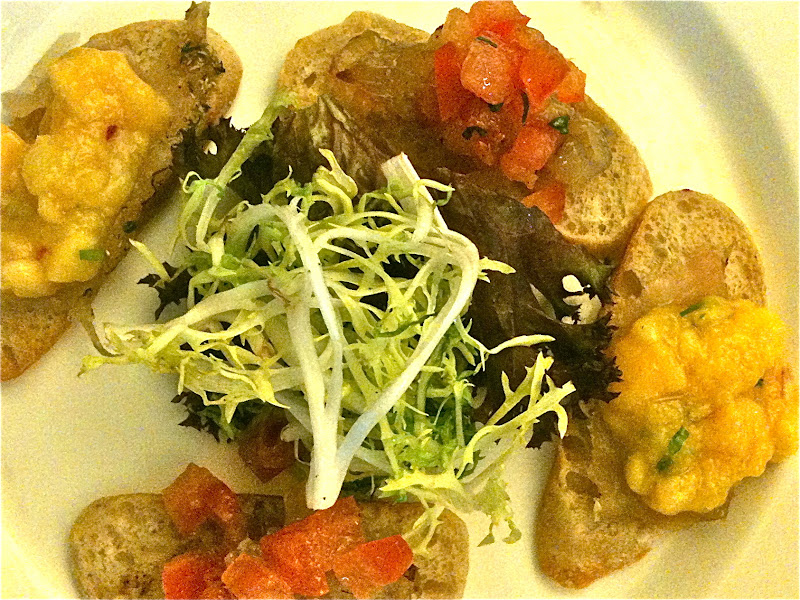
I chose a cured fish starter - if you've been reading my blog, you know I'm an incurable cure-r, having done home-cured salmon and home-cured pancetta. My dish came with a cured red snapper paired with diced tomatoes, and cured mackerel with mango, served on a biscotti that had gone soft and retoasted, I think. The mackerel smelled and tasted fishy, like otah (fish paste). The red snapper however was lovely to the bite, and tasted very fresh and beautifully cured, just the right taste and texture for me, and I rushed home to research more about cured red snapper - with vodka! (Who's ready for the next private dining seating on this??!)

My main was an interesting composition of lentils wrapped in black crepes in a mixed garlic herb sauce, with honey roasted pumpkins, and topped with fried leeks. Vegan. I'm learning to wake my palate and taste in a deliberate fashion, always conscious of the effect the food and each ingredient has on my tastebud. This dish, I enjoyed, although half a portion would have sufficed for me. The lentils had a Middle Eastern-Moroccan twang, and the leeks were very flavourful. Even the green sauce was palatable to me, and seemed appropriate with St Patrick's Day round the corner.

 I asked our student-waiter what made the crepe black, making it look like a Japanese seaweed. He smiled and said, Today's crepe is darker than it should be! Essentially, it's blackened using 2 ingredients, black bean puree and bamboo charcoal powder. That word again. I had just blogged about it a month ago - see post on Black Bread.


Poor girl had to go into the kitchen to bring this out to show me.
At the rate I'm going, I may be "black"-listed and banned from
coming back to this restaurant!
And here's our trio dessert: 1. Coconut sorbet with dragon fruit cubes and candied parnsips. The parsnip took the limelight from the sorbet.


 2. Yuzu tart with raspberry sauce. It was ok, ok - know what I mean? Like, forgettable.


3. Warm apple cake with a dollop of vanilla ice cream. This was the most humble and heart-warming dessert. In my friend's words and with hand to heart and a peaceful sigh, he said, Eating this just makes me feel so happy. Soul Food. I want my food to have this effect on my diner! 


My curiosity still unsatiated, I asked if I could have a tour of the kitchen. They willingly obliged. (God, that woman!) The student-sous chef brought us round, boasting of their state-of-the-art equipment and a chill room for salad and cake preparatory work to ensure freshness. I unabashedly asked the Executive Chef from the States if she was open to sharing her recipes or if they were trade secrets. For my audacity, I was rewarded with the recipe for the apple cake, her father's recipe from her hometown back in New York. Will post when I get to test it. Overall, well done to the student-chefs and the service crew. I would really like to be back there soon. And this time, with a decent camera. Ciao for now!


Sunday, November 27, 2011

Tandoori roti and naan


I have been asked a few times for the roti and naan recipe since I first blogged about it - click here for my Tandoor post. It's taken a while but here it is finally.

Recipe A

Tandoori roti (Tandoor bread with whole wheat flour)
Origin: North India
Serves: 2

180gm Whole wheat flour/ Atta
1/2 tsp Baking powder
2 Tbs Oil
100 ml Water
Salt to taste


Method:
1. Combine flour, salt and water to make a dough that is very soft yet not too sticky. Let rest for about 10 minutes, cover with damp cloth. Dimple the dough to catch the oil. Then add oil and turn the mixture out onto a floured board and knead by hand for 5 minutes.
2. Roll the whole dough into a ball and cover with a damp cloth and set aside for about an hour.
3. Knead the dough again for a few minutes and break it into 4 even pieces.
4. Flatten each ball with hands while dabbing with a little flour. Using a rolling pin, create circles about 6 inches in diameter
5. Using a pad stick the rolled out bread on the wall of a hot tandoor.
6. Cook for a minute and take out using the special skewer.
7. Brush with butter and cut into two before serving.

You can see which ones are done by Chef, and the one done by me!

I have not tried doing this in my home oven. Temperature in the tandoor is about 500C so if I try, I would set to the highest possible temperature in my own oven, the same way I would do for pita bread and pizzas. 

Special skewers to remove bread from the tandoor.


Recipe B
Naan (Tandoor bread with plain flour)
Origin: North India
Serves: 2

225gm Refined wheat flour/plain flour
25 ml Oil
80 ml Water
30 ml Yoghurt
5 gm Sugar
1/2 tsp Baking Soda
60 ml Melted butter for brushing
Salt to taste


You have to watch an Indian knead his dough. Some things are taught and some things are caught!


Method:
1. Combine flour, baking soda, yoghurt, salt, sugar and water to make a dough that is very soft yet not too sticky. Let rest, cover. Dimple. Then add oil and turn the mixture out onto a floured board and knead by hand for 5 minutes.
2. Roll the whole dough into a ball and cover with a damp cloth and set aside for about an hour.
3. Knead the dough again for a few minutes and break it into 4 even pieces.
4. Flatten each ball with hands while dabbing with a little flour. Using a rolling pin, create circles about 8 inches in diameter
5. Using a pad stick the rolled out bread on the wall of a hot tandoor.
6. Cook for a minute and take out using the special skewer.
7. Brush with butter and cut into two before serving.

As I'm on a low carbo track, I have not come back to try this recipe since graduating from the culinary school. I'm posting this specially for readers who are keen on trying. Please come back and tell me if you try this. Good luck!


Wednesday, November 2, 2011

Word of the Week: Rempah

Many people, my mom included, believe a good rempah can only be made using mortar and pestle.
A food processor is a strict no-no.

Rempah - I learned this word from a classmate in culinary school during our lesson on Malay cuisine.  Apparently a common term amongst Peranakans (Straits Chinese), Rempah is a Malay word used to describe the spice paste used in many dishes throughout Southeast Asia.

I've never been big on chillies and spicy food but the Chef who specialised in Malay cuisine changed my mind and palate, and I have a much deeper appreciation now for rempah. Here's a typical rempah recipe which I absolutely adore - the die-die-must-try sambal roast chicken. I have tested this dish and received good feedback from family and friends. It's worth every calorie count! See if this picture helps to entice you to try it.


And in view of the coming holidays, let me end on this note. The Little Drummer Boy knew something about rempah that others didn't. Hear ye, hear ye!

Come, they told me, pa-rempah-pum-pum
A new born King to see, pa-rempah-pum-pum
Our finest gifts we bring, pa-rempah-pum-pum
To lay before the King, pa-rempah-pum-pum
Rempah-pum-pum, Rempah-pum-pum
So to honour Him, pa-Rempah-pum-pum
When we come.

Monday, September 26, 2011

Minced chicken and tofu wrapped in cabbage leaves


Rather pleased that I did this all by myself without any chef or mom supervision or assistance. It's a miracle the thing didn't disintegrate but remained faithfully intact throughout the cooking process. Taste is decent too. Here's the recipe for those who are interested.

Verdict: It's easier than it looks. Nutritious and healthy too. Truly Asia.

Send this to a friend and try it out at your next cook-out!


Wednesday, September 21, 2011

Dal Makhani cooked in Chinese home with Dutch oven

My Dal Makhani that smells and looks more like baked beans for Western breakfast
I learned this dish in at-Sunrice culinary school from an Indian chef. Click here to see how he taught us. It's called Dal Makhani meaning lentils stewed with butter and tomato. The cooking method and process is simple and straightforward but the preparation for the ingredients was something else. You can see from the recipe here that there are almost 20 ingredients in this dal. Especially for someone like me in a Chinese home where such ingredients are not common, I procrastinated on this dish just thinking of the massive mise en place needed. Until today.

What you see here are just half of the ingredients needed!
Clockwise from top left: Kidney beans, bay leaf, channa, urad, cumin,
Kashmiri chilli powder (more for colour than kick), tomato paste, ghee
(which I didn't use in the end), cloves, cinnamon sticks, cardamon, fenugreek 
The beans are soaked overnight and boiled for a good 2 hours.
My beans were soft but not disintegrated enough.
They smelled good during the boil.

I used my Dutch oven and I tried to do a step-by-step photography and my camera almost ended up in the stew. It almost became Dal MaCanon! 

The beans are still very much in its individual state. Maybe this may look more like authentic dal tomorrow
when I reheat it. The taste is not too bad, except I may have used a little too much tomato paste and it smelled like oxtail stew and looked like baked beans.
I think garnishing is particularly important in Indian cuisine where everything tastes great when they're all mashed together. Here, I pick some fresh basil from my garden.

Need another attempt on this dish and I should be ready for Diwali. Meanwhile, read this on the numerous benefits of Indian herbs and spices and see if you'll be more tempted to try this recipe.


Monday, September 12, 2011

A quick salad dressing


A vinaigrette dressing in its simplest form consists of olive oil and lime juice. Here, I add honey, wasabi, salt, spring onion and shallot. And I have some cherry tomatoes to get rid of, so these go in as well. Took me 3 minutes to assemble this. It's good to use a glass jar for easy mixing and storing.

I plan to use this dressing for a prawn mango salad tonight. I don't have avocado but I figured I can get by with just the prawns and the mango. I also remember in our portioning class that it's about 25g of greens per head and I have prepared 3 portions tonight of baby spinach and mixed greens. Quick, fast, cheap, healthy.

Sometimes, I use high end stuff and some days, I just use
anything I can get my hands on.