Showing posts with label Ingredients. Show all posts
Thursday, August 9, 2012
Word of the Week - Molasses
Not to be confused with sandstones near mountain bases called molasse, Molasses in the culinary world are the by products from beating sugar cane. Juice is first extracted from the cane, and thereafter, boiled to become concentrated. The caramelization of the sugar results in molasses. The quality of molasses depends on the maturing of the sugar cane.
Essentially, there are 3 rounds of boiling resulting in 3 grades of molasses - mild, dark, blackstrap. The first round of boiled juice retains the highest amount of sugar, the second round gives off a slightly bitter taste, and the final round produces high grade blackstrap which gives off a robust flavour. It also contains a higher level of vitamins and minerals and is sometimes given as health supplements, serving out a good source of calcium, magnesium and potassium.
Its texture is rich like honey and the taste is finger licking good. Get the unsulphured version which has no preservative (sulphur dioxide) added in the treatment process.
Molasses is used in dark brewed beverages such as stout and dark ales, and it is also a common ingredient in baking. Check out my next post on a Molasses Kahlua Cake.
Saturday, June 23, 2012
Word of the Week - Salmon
What makes salmon orange? What is the difference between farmed salmon and wild salmon, in terms of nutrients and price? Where can you buy wild salmon? How do you know if what you've paid for is wild or farmed?
These questions have been twirling in my head for quite some time now, and this post is an aggregate of my desktop research findings plus conversations with chefs and fishmongers.
First question - how to pronounce salmon? Sell-mon? Sull-mon? Actually, the L is silent, so it's Sau-mon. Like "palm" and "psalm" where you don't sound the L. (Did you know Thailand is pronounced Tai-land, not Thigh-lern?)
The actual colour of salmon flesh ranges from white to pink to orange, depending on the level of asthaxanthin, something that the wild salmon fish get from feeding on crustaceans (shrimps, lobsters, etc..). Those that are farmed are fed with an orange dye (how horrid is that?!) so they look like wild salmon!
More than 80% of salmon in the market are farmed, some sites say up to 90%. If it's an Atlantic salmon, it is highly likely a farmed one. Any nutritional differences? Loads. Farmed salmon are far inferior, providing less beneficial Omega 3 fats than their wild kin. Pumped with antibiotics and dyed orange, they are also more exposed to pesticides. The wild salmon boast 20% higher protein content and 20% lower fat content than farm-raised ones. The US Department of Agriculture confirmed these unfortunate statistics.
Canned salmon are likely wild salmon as the farm-raised ones are not suitable to be canned.
Where does this leave us? Well, I don't even know where to buy wild salmon. Do you?
Friday, June 22, 2012
Home-grown bananas, the thrill of city dwellers
So there, I finally harvested my first bunch of bananas. They have kept me waiting patiently for 15 months. See the miraculous reproduction process and how they looked as babies here. I had seen lots of them growing in the kampung I grew up but this is my first experience growing a banana tree by myself. It's usually watered by rain but most days, we use the rice water that we would otherwise have thrown away. So this is a 100% certified organic banana tree.
![]() |
| My total harvest came to more than 10kg! |
They may look green on the outside but they are soft, ripe and sweet on the inside. I was wondering when to harvest them the past month as they seemed fattened enough. Read some blogs on it but still couldn't make out. It was a clear sign when the squirrel came and started sniffing them and tried to eat them. God is a miracle-working God!
I love the idea that I can be so close to my food source. I should have been a farmer's wife.
| So perfectly formed, and I only had to water them. |
Saturday, June 9, 2012
Word of the Week - Mentaiko
Mentaiko (or Ming Tai Zi) is essentially marinated roe of pollock, a kind of marine fish. What I have here is spicy roe, a common ingredient in Japanese cuisine. You may have eaten it without even realising it's there. The name derives from Mentai, which means pollock in Korean. It can be eaten on its own with sake, and is in fact, nominated as the best side dish by one of the Japanese magazines.
My husband got this for me from the airport in Tokyo, 1000 Japanese Yen (about US$10) for 100g, about half the price of what you get in Singapore.
To use as an ingredient or to serve, simply cut the sacs and scrap the roe off with a teaspoon.
Scrap gently and you are left with the membrane as shown here.
The packet I got yielded this much Mentaiko.
Look out for my Mentaiko Pasta in the next post!
Saturday, April 28, 2012
Word of the Week - Balsamic Vinegar
![]() |
| My 7-year aged balsamic vinegar from a dear friend |
Balsamic vinegar is strictly not a wine vinegar. It is produced in the Modena region of Italy from reduced wine juice aged in wooden casks. Highly valued by chefs and gourmet food lovers, it gives off a smooth sweet-sour flavour and is perfect as a salad dressing, or poured over grilled meat, or paired with a good extra virgin olive oil peppered with good quality sea salt flakes as a dip for crusty breads.
There are 3 different grades of balsamic vinegar.
1. Traditional Balsamic Vinegar of Modena. This label is protected under the European Union and is exclusively used only for those produced in Modena and aged for a minimum of 12 years.
2. Condimento grade - there is some aging involved in this grade. My photo above is such an example, a gift from a dear friend who toured Napa Valley and thought of me. This bottle is aged 7 years. I love how it's suspended inside the bottle too.
3. Commercial grade - zillions of gallons are produced in this commercial grade where no aging is involved. In fact, there are colourings and thickeners used in this low grade that is produced on a mass scale. My personal recommendation is not to put your money on this category.
Be an informed consumer and look out for these labels when you next shop for a balsamic vinegar. Without the word "Aceto Balsamico Tradizionale", you know it's not aged for a minimum of 12 years.
Friday, April 20, 2012
My Banana Tree - Part 2
Remember the banana tree I told you about? See my earlier post on this here when it was just a baby. Well, here's an update of it. It looks really good and is growing up to be a fine, organic banana in my backyard. God's creativity is so mind-blowing. How did He decide that bananas should form this way? I'm really excited to know when I can take it down.
Tuesday, April 17, 2012
Word of the Week: Poppy Seeds
I have been trying to get my hands on Poppy Seeds for more than a year. Today, thanks to a dear friend from Perth, I got more than 200g of this precious ingredient! It is a prohibited item in Singapore - silly as it sounds - because these oil seeds come from the opium Poppy. But these dried seeds are primarily for culinary uses, as a spice, a thickener, a garnish, or a condiment. They are used in many baked goods and desserts. You need more than 3,300 seeds to make one gram! Here's more of what's said about poppy seeds on this packaging.
Next post: Sticky Lemon and Poppy Seed Cake
Saturday, April 14, 2012
Word of the Week: Cinnamon
Cinnamon is a spice obtained from the inner bark of certain trees native to Southeast Asia. It is also mentioned in the Bible when Moses was instructed to add cinnamon to the holy anointing oil. The aroma comes from the essential oil present in this bark. Some people don't like the taste or smell, but I've found it to be divine, especially when used in baking.
I saw the Cinnamon Challenge on the web, where a person tries to eat or swallow a full tablespoon of ground cinnamon under 60 seconds without drinking and then posts their video online for all to laugh at. Can you believe this competitive eating challenge has been around for more than 10 years? I strongly advise you not to try it - there is a toxic chemical compound in cinnamon called coumarin that can induce coughing and gagging if you inhale it.
![]() |
| Giant cinnamon sticks next to vanilla pods |
Wednesday, March 28, 2012
Word of the Week: Vanilla
There's nothing plain about vanilla. It is the second most expensive spice after saffron, because growing the seed pods is labour-intensive. It has a complex floral aroma and is highly priced for its flavour. It is widely used in commercial and home baking, in perfumes and in aromatherapy.
In my recent trip to Bali, I picked these up from the local spice market. They smell awesome - I mean, to come home to a luggage smelling of vanilla instead of the usual dirty laundry or airplane smell is quite something of a new experience. I have since used them in a bun pudding as well as in the apple cake I baked last night.
Baking with something straight out of a plant beats any type of essence, pure, natural or artificial, no matter how highly you may esteem them.
See last week's Word of the Week.
Her father's Warm Apple Cake
I mentioned last week that I got this recipe from an American chef in the Culinary Institute of America in Singapore. She named it, My father's Warm Apple Cake. A quick look around the kitchen and I realised I have all the ingredients in the recipe. I like recipes like that - no special ingredients to buy, just things you can find around the house.
The method is also fairly straightforward - mix all the dry ingredients. Then mix all the wet together and bake it. No sieving, no melting, no proofing, no frosting (unless you prefer). Serve with a dollop of vanilla ice cream you get at the stores.
Recipe and method below.
| I was told it's usual and expected for oil cakes to dome like mine here. I actually enjoy seeing the top crumble. |
Ingredients
Chopped apples 330g (I used 3 Granny Smith and did not even bother to peel them!)
Plain flour 450g (Ran out of plain after measuring out 350g and topped up with self raising flour!)
Sugar 420g (Way too much for my taste. I used 300g. Will try 250g next time round.)
Baking soda 1 tsp
Salt 1 tsp
Cinnamon powder 2 tsp
Vanilla extract 2 tsp (I used vanilla pods I bought recently in Bali)
Eggs 135g (I used 3 small eggs)
Canola oil 320g (Ran out of canola and mixed it with EVOO, tsk tsk)
Walnuts & pecans 1 cup
Method (only 2 steps)
1. Using the well method, mix the wet ingredients into the dry ingredients.
2. Bake in oiled ring mould at 300F/170C for 60 minutes or until golden brown.
How I would do it differently next time round
1. The batter was still wet after 60 min when tested with a wooden stick so I gave it another few minutes. But if you think about it, there is no such thing as an uncooked apple cake since all the ingredients can be eaten as they are! I remember the one I ate at the CIA was super moist. So the next time round, I would not even test with the stick and simply remove it when the time is up or when it turns golden brown. It should taste better. Who would like to try my next improved version warmapplecake2.0 ?
2. The aroma coming out of the oven was supremely divine after 30 minutes of baking. I would time it to the arrival of my guests next time round!
3. I would serve it with a warm vanilla sauce - another level of divinity.
Verdict: forget the usual boring apple crumble or apple pie. Apple cake is da' bomb! Cakes with nuts and fruits are so much more of my favs than those with heavy icing. I guess that's why I have till now not attempted any of those pretty cup cakes, against the wise sagely advice of all the teenagers in my life.
Thursday, March 15, 2012
Kitchen Organisation
Nothing pretty like my dear friend's in Germany. Mine is purely functional, but I'm loving it.
Monday, February 20, 2012
My Banana Tree
After nine months of waiting, my banana tree finally flowered last week and today, the flower starts to split into something resembling a bunch of bananas! What a miraculous process from God. He is so creative and imaginative! This is no less miraculous as foetal development, and I am now one more step closer to home organic bananas.
This is definitely one way to get as close to my food source as possible without becoming a farmer's wife!
See my pictures over the past 9 months at different stages.
Thanks to my dear friend EK for giving me the sapling last year.
Monday, January 23, 2012
French Confit Toast
Duck fat and I
I'm in a relationship with duck fat. It's complicated.
Here's the amount of fat collected from one roast. The juices will sink into the bottom making it easier to separate them.
Use duck fat to roast divine potatoes or heavenly carrots and you'll never go without this baby ever again!
- Posted using BlogPress from my iPhone
Thursday, January 12, 2012
Italy - a working farm
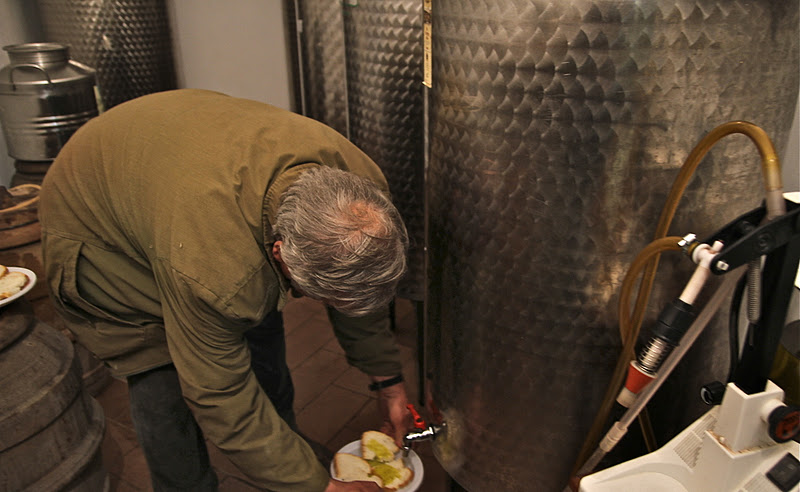
Today, we visited Luciano's working farm just 10 minutes drive from our farmhouse at Cretaiole. He had just slaughtered 2 pigs yesterday and today, he has invited us to come over at 4pm to see what he's doing with them. We walked into this what looks to me like a murder scene in a farm barge. Here, Luciano's men are stuffing pork sausages. On the left, you can see their home-bottled tomato paste.
Luciano cures his own meat - these above are more than a year old hanging next to his wine barrels.
He lifts up this netted crate to show us his cured cheese as well.
We also tasted his extra virgin olive oil fresh from the infusion and before bottling.
It was a totally enjoyable visit and I wish I could be a farmer's wife ... maybe just for a little while!
Sunday, November 27, 2011
Baked Sunny Eggs in Ramekin
| It takes some skills to spoil a breakfast. Even an extra virgin chef can't do it. |
This dish is great nutrition all packed into one little ramekin - Baked Sunny Eggs with roasted tomatoes and garlic sautéed spinach. What better way to start off your Sunday. Food to get you in the mood.
|
|
| This one took a bit longer and you can see the eggs are firmer. |
If you like this post, please share it with your friends. A little Like goes a long way.
Ready to take one step further? Fancy trying to make your own burger? Click here to see my McVirgin burger.
Saturday, November 12, 2011
An ingredient worth its salt.
Ever since Eli introduced me to Atlantic sea salt, I got more and more curious about this ingredient. The bible calls us "salt of the earth". I also saw this in Colossians 4:6 - "Let your speech always be gracious, seasoned with salt, so that you may know how you should answer everyone." So there's truth in the saying, You are what you eat.
Look at the different kinds of salt I bought recently.
![]() |
| This tastes great when I sprinkle over a salad or just as a bread dip in extra virgin olive oil. |
![]() |
| Now, isn't this pretty in pink? |
| See how coarse each grain is. |
I am going to use this pretty thing to cure a piece of pork belly I have and experiment with a home-made pancetta.
Salt is also a critical ingredient when you cure salmon. The science of it is totally fascinating - as the salt extracts water from the salmon, bacteria is deprived of a conducive environment to breed. There is more to it than meets the eye when the bible tells us to be the salt of this earth.
Subscribe to:
Posts (Atom)